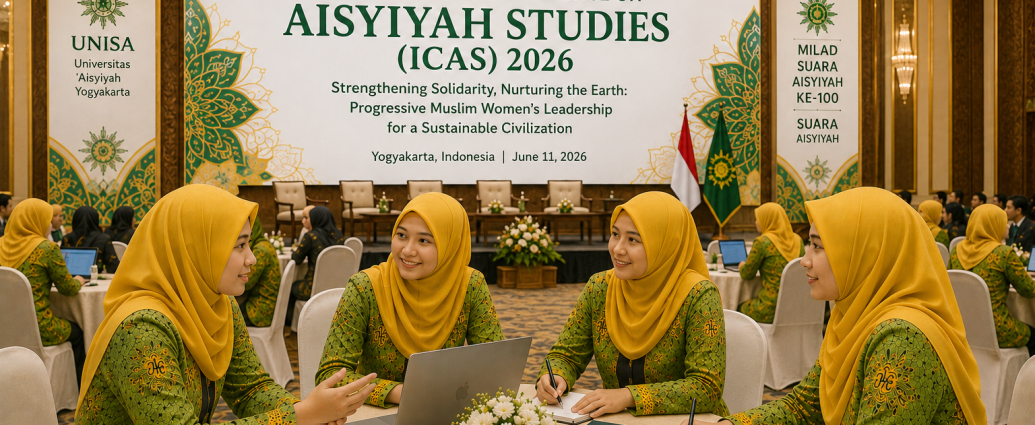
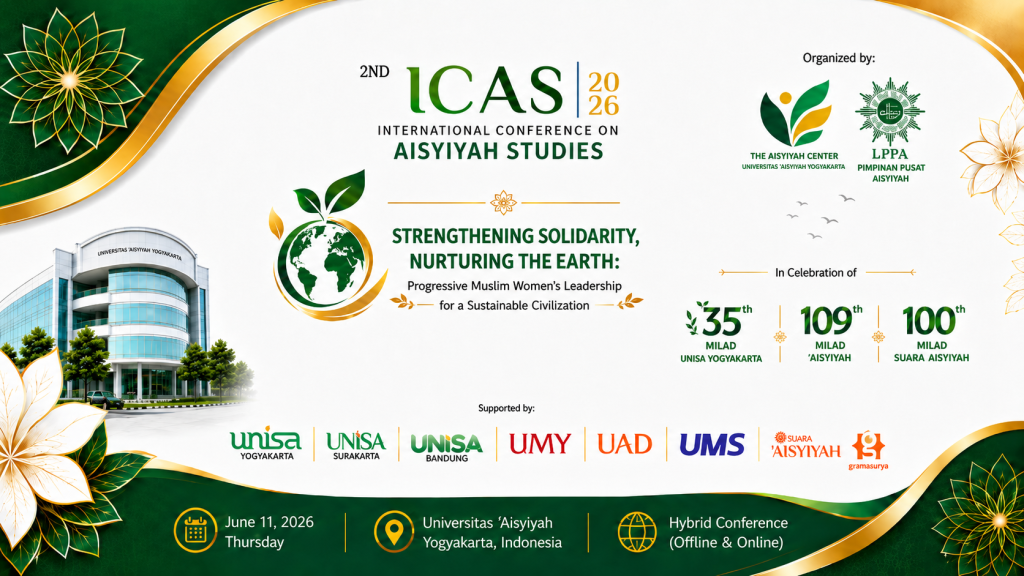
In celebration of the 35th Anniversary of Universitas ‘Aisyiyah Yogyakarta, the 109th Anniversary of ‘Aisyiyah, and the 100th Anniversary of Suara ‘Aisyiyah, The Aisyiyah Center (TAC) of Universitas ‘Aisyiyah Yogyakarta, in collaboration with LPPA Pimpinan Pusat ‘Aisyiyah, proudly presents the International Conference on Aisyiyah Studies (ICAS) 2026.
ICAS 2026 is an international interdisciplinary forum that brings together scholars, researchers, students, activists, educators, policymakers, community leaders, and practitioners from various countries to discuss contemporary issues surrounding Muslim women, religion, social transformation, sustainability, health, education, digital culture, and global civilization.
As societies around the world face interconnected challenges—including environmental degradation, technological disruption, social polarization, economic inequality, and declining public trust—there is a growing need for ethical reflection, collaborative action, and inclusive leadership.
For more than a century, ‘Aisyiyah has contributed significantly to education, healthcare, social welfare, philanthropy, community empowerment, and intellectual development. Inspired by this legacy, ICAS 2026 seeks to position Aisyiyah Studies within broader international conversations on religion, gender, sustainability, public ethics, and social transformation.
Why Aisyiyah Studies Matter Today
More than a century after its establishment, ‘Aisyiyah continues to provide valuable perspectives on education, women’s leadership, public health, social welfare, environmental ethics, philanthropy, and civic engagement.
Studying ‘Aisyiyah is not only about understanding an organization. It is about examining how Muslim women negotiate modernity, shape public discourse, contribute to nation-building, and participate in global conversations about justice, equality, sustainability, and humanity.
In the contemporary world—marked by rapid digital transformation, shifting religious authority, and changing social structures—Aisyiyah studies also offer important insights into how Islamic movements adapt, transform, and remain socially relevant across generations.
ICAS 2026 therefore seeks to position Aisyiyah studies within broader international discussions on religion, gender, sustainability, public ethics, and social transformation.
Objectives of the Conference
General Purpose: To provide a global academic platform for disseminating research findings, ideas, and best practices related to the role of ‘Aisyiyah and progressive Muslim women’s movements in addressing global civilizational challenges.
Specific Objectives:
To explore the historical and contemporary contributions of ‘Aisyiyah in education, health, law, economy, and politics at local, national, and international levels.
To analyze challenges and opportunities for progressive Muslim women’s movements amid global issues such as climate change, digital transformation, and social justice.
To formulate research agendas and strategic actions for ‘Aisyiyah in preparation for the 2027 Congress and in response to future civilizational needs.
To strengthen collaborative networks among academics, activists, and ‘Aisyiyah leaders worldwide.
To produce high-quality academic outputs in the form of indexed proceedings, special journal issues, and an edited volume.
Grand Theme
Strengthening Solidarity, Nurturing the Earth: Progressive Muslim Women’s Leadership for a Sustainable Civilization
This grand theme highlights the urgent need to reconnect social justice, ecological responsibility, spirituality, public ethics, and human dignity in responding to contemporary global challenges. ICAS 2026 explores how Muslim women’s leadership can contribute to building sustainable futures grounded in solidarity, compassion, knowledge, inclusivity, and collective care.
Conference Topics
The conference welcomes papers related, but not limited, to the following themes:
History, Thought, and Movements: The legacy of ‘Aisyiyah women’s leadership in nation-building.
Women and Ecological Justice: Theological perspectives and ‘Aisyiyah’s practices in climate change mitigation and environmental activism (eco-jihad).
Da‘wah and Digital Transformation: Innovations, opportunities, and challenges of ‘Aisyiyah in cyberspace.
Health, Well-being, and Family Resilience: Responses to global health issues, stunting, mental health, and shifting gender roles.
Economic Empowerment and Social Justice: Social entrepreneurship, green economy, and ‘Aisyiyah’s role in poverty alleviation.
Law, Politics, and Citizenship: Advocacy for women and children’s rights and strengthening democracy.
Cross-Border Networks: ‘Aisyiyah’s role in diplomacy, global peacebuilding, migration, and interfaith dialogue.
Media and Literacy: The role of Suara ‘Aisyiyah and media in shaping progressive Muslim women’s discourse.
Empowering for Vulnerable Society : Elderly, Disabilities and Minority Group.
Registration Fee
Participation in ICAS 2026 is free of charge. While participation in the conference is free of charge, participants are kindly informed that the organizing committee will only provide access to the conference venue and lunch during the event. All other expenses, including transportation, accommodation, and personal costs, are the responsibility of the participants.
TECHNICAL GUIDELINES
Conference Format
ICAS 2026 will be conducted in a hybrid format, allowing participants from various countries to join either physically or virtually.
Date: June 11, 2026 Venue: Ruang Sidang, Siti Moendjijah Building, 2’nd Floor, Universitas ‘Aisyiyah Yogyakarta, Indonesia Format: Hybrid Conference (Offline and Online) Organizer:
The Aisyiyah Center (TAC) – Universitas ‘Aisyiyah Yogyakarta
LPPA – Pimpinan Pusat Aisyiyah
Offline participants will attend sessions directly at the conference venue in Yogyakarta, while online participants will join through a virtual conference platform provided by the organizing committee.
Types of Participation
ICAS 2026 welcomes several categories of participants:
Presenter Participants whose abstracts and full papers are accepted will present their research either online or onsite. Presenters are expected to actively participate in academic discussions and panel sessions.
General Participant Individuals who wish to attend the conference without presenting a paper may register as general participants.
Invited Speakers The conference will also feature distinguished scholars, researchers, and practitioners from various countries who will contribute through keynote lectures and special panel discussions.
Online Participation and Zoom Access
Participants who choose the online participation mode may join the conference through the official Zoom platform provided by the organizing committee. The conference Zoom room can be accessed using the following details:
Online participants are encouraged to join the meeting at least 15 minutes before the scheduled start of the conference to ensure a smooth login process and to address any technical issues. Presenters should prepare their presentation materials in advance and ensure that their internet connection, microphone, and camera are functioning properly.
For parallel sessions, participants will be assigned to their respective thematic panels according to the conference program (see the Parallel Sessions below).
To facilitate identification and attendance verification, participants are kindly requested to use their full name and institutional affiliation when joining the Zoom meeting. Active participation and professional online etiquette are highly appreciated throughout the conference.
Rundown
The Conference Program (Rundown) provides an overview of all ICAS 2026 activities, including the opening ceremony, keynote addresses, plenary sessions, parallel paper presentations, networking opportunities, and closing session. The schedule is designed to facilitate meaningful academic exchange while ensuring adequate time for discussion and collaboration among participants. Presenters and attendees are encouraged to review the program carefully and follow the designated schedule for their respective sessions. Any updates or adjustments to the program will be communicated by the organizing committee prior to the conference.
The core academic activities of ICAS 2026 will take place through a series of parallel sessions designed to facilitate focused discussion, scholarly exchange, and constructive feedback among participants.
Parallel sessions will be conducted in two formats:
Offline Parallel Sessions, held at Universitas ‘Aisyiyah Yogyakarta.
Online Parallel Sessions, conducted through the conference’s virtual platform.
The detailed schedule and allocation of sessions can be found below:
Both offline and online parallel sessions will be organized into several thematic panels. Each panel will consist of a maximum of eight presenters and will be led by a designated Session Chair. This structure is intended to ensure sufficient time for presentation, discussion, and academic interaction.
Each presenter will be allocated a maximum of 10 minutes to present their paper. Presenters are therefore encouraged to focus on the key arguments, methodology, major findings, and implications of their research. Following the presentations, the Session Chair will facilitate discussion and questions from participants.
To maintain consistency and professional presentation standards throughout the conference, presenters are strongly encouraged to use the official ICAS 2026 Presentation Slide Template, which is available for download below. The template has been specifically designed to reflect the visual identity of the conference while providing a clear and effective format for communicating research findings.
Responsibilities of Session Chairs
Session Chairs play an important role in ensuring the quality and effectiveness of academic discussions. Their responsibilities include:
Opening and introducing the session.
Managing presentation time and ensuring adherence to the schedule.
Facilitating questions and discussions.
Encouraging constructive scholarly engagement among participants.
Providing brief reflections or comments on the presentations where appropriate.
Ensuring an inclusive, respectful, and academically rigorous environment.
Session Chairs
ICAS 2026 is honored to be supported by a distinguished group of scholars and academic leaders who will serve as Session Chairs:
Kurnia Hastuti Dewi, PhD.
Syafika Dhea Taqiya Ramadhani, M.Sc.
Witriani, PhD.
Nur Faidati, PhC.
Wantonoro, Prof.
Islamiyaturrahmah, PhD.
Herni Ramdlaningrum, MPP.
Mutiah Amini, Prof.
Cesa Septiana Pratiwi, PhD.
Reynie Purnama Raya, SKM., M.Epid
Annisa Ridlayanti, S.Keb.,Bd.,M.Keb
Endang Koni Suryaningsih, PhD.
Siska Ningtyas Prabasari, M.Sc., Ns-Mid.
Aisyah Mutia Dawis, S.Kom., M.Kom.
Aulia Uswatun Khasanah, SE., MM.
Presentation Slide Template for ICAS 2026
To ensure a professional, consistent, and visually coherent presentation throughout the conference, all presenters are kindly encouraged to use the official ICAS 2026 Presentation Slide Template.
The template has been specifically designed to reflect the visual identity of ICAS 2026 and its overarching theme, “Strengthening Solidarity, Nurturing the Earth: Progressive Muslim Women’s Leadership for a Sustainable Civilization.” It incorporates the conference branding, commemorative milestones, and visual elements associated with Universitas ‘Aisyiyah Yogyakarta and the spirit of progressive Muslim women’s leadership.
The template provides a clean and spacious layout that allows presenters to communicate their ideas effectively while maintaining a unified appearance across all conference sessions. Presenters may customize the content, figures, tables, and visual materials according to their presentation needs, while preserving the overall design structure of the template.
We strongly encourage all presenters to use this template during their presentations, both for onsite and online sessions, as part of our collective effort to enhance the academic quality and professional atmosphere of ICAS 2026.
To facilitate a smooth and efficient flow of the parallel sessions, all presenters are kindly requested to upload their presentation slides prior to the conference through the link provided below. Early submission will help Session Chairs and technical staff prepare the presentation materials in advance, minimize technical delays, and ensure that each presenter can make full use of the allocated presentation time.
Presenters are strongly encouraged to use the official ICAS 2026 Presentation Slide Template and upload the final version of their slides no later than June 10 2026. Thank you for your cooperation in helping us maintain a professional and well-organized conference experience.
THE SPEAKERS AND MODERATOR
ICAS 2026 will feature distinguished scholars, researchers, activists, public intellectuals, and practitioners from various countries who have made important contributions to the study of Islam, Muslim societies, gender, education, social transformation, public health, anthropology, communication, sustainability, and global civilization.
The conference aims to create meaningful dialogue between academic scholarship and lived social realities by bringing together voices from different disciplines, institutional backgrounds, and cultural contexts.
Through keynote lectures, panel discussions, and special sessions, the invited speakers will explore contemporary issues surrounding Muslim women’s leadership, faith-based social movements, digital transformation, ecological responsibility, humanitarian challenges, and the future of ethical civilization.
The speakers represent diverse perspectives and experiences from Indonesia and the international academic community, reflecting the interdisciplinary and global spirit of ICAS 2026.
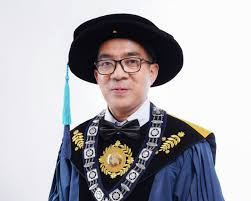
Prof. Brian Yuliarto is the Minister of Higher Education, Science, and Technology of the Republic of Indonesia as well as a Professor of Nanotechnology at Bandung Institute of Technology (ITB). Widely recognized for his contributions to scientific research and technological innovation, he has played an important role in strengthening Indonesia’s higher education and research ecosystem, particularly in the fields of nanotechnology, advanced materials, and academic innovation.
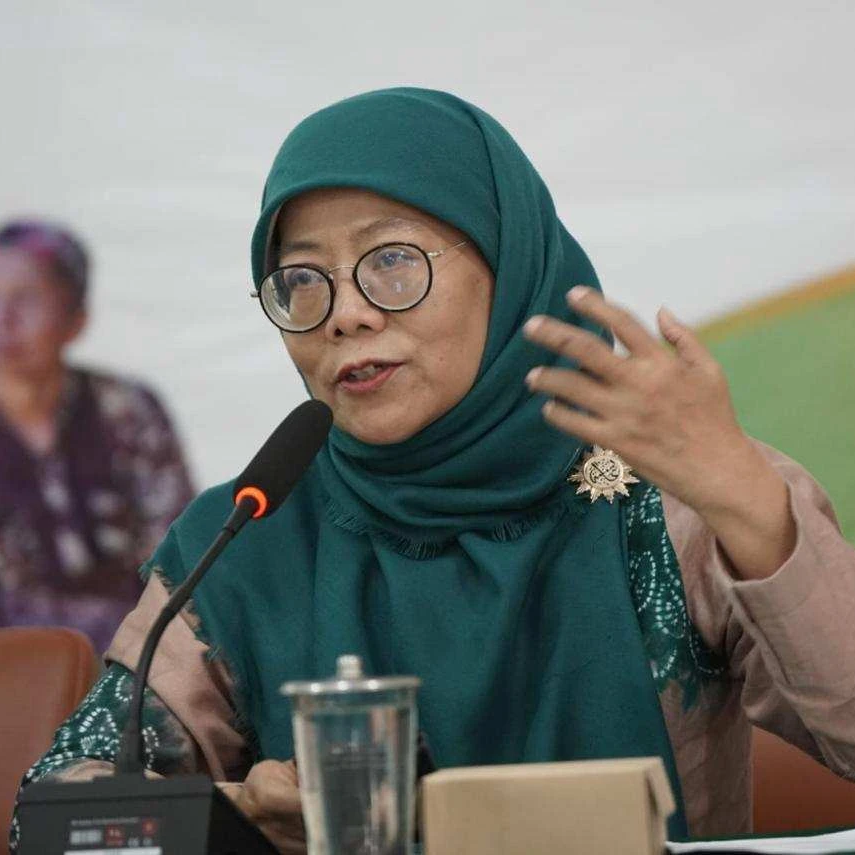
Dr. Salma Orbayinah is the Chairperson of Pimpinan Pusat ‘Aisyiyah, a pharmacist, and a lecturer who has been actively involved in the advancement of Islamic women’s leadership, public health, education, and community empowerment. Through her academic, organizational, and social engagements, she continues to contribute to the development of progressive Muslim women’s movements, particularly in promoting social welfare, gender equity, and humanitarian values at both national and international levels.
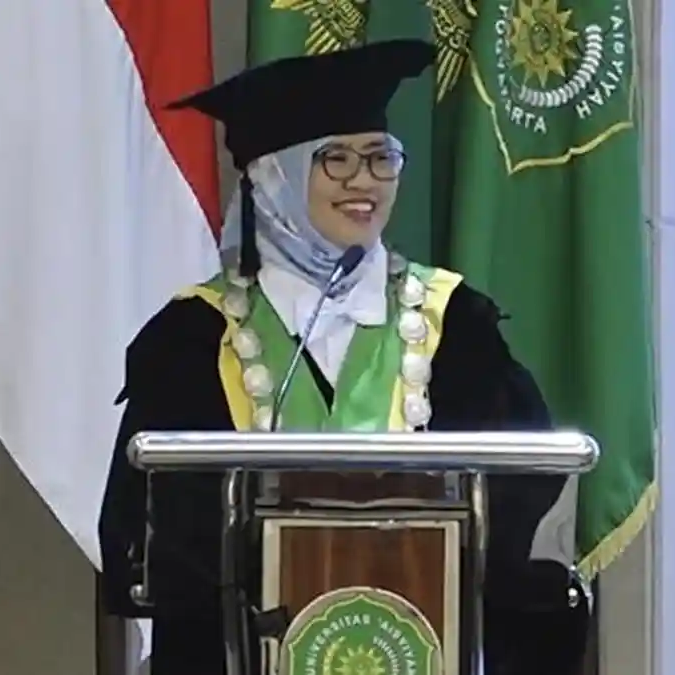
Dr. Warsiti is the Rector of Universitas ‘Aisyiyah Yogyakarta (UNISA), a nursing scholar, and an academic leader who has played an important role in advancing higher education, women’s empowerment, health sciences, and institutional transformation. Through her leadership, she actively promotes the integration of Islamic values, scientific development, humanitarian engagement, and global collaboration in responding to contemporary social and educational challenges.
Prof. Dr. Siti Ruhaini Dzuhayatin is a leading Indonesian scholar-practitioner in gender and human rights whose work bridges academic research, policy advocacy, and diplomacy. As a diplomat and professor, she brings grounded insight into how women’s leadership shapes governance, protection frameworks, and cross-border collaboration. Her expertise is especially relevant to ICAS 2026’s focus on solidarity and sustainability, because she connects ethical commitments with institutional change—showing how values become actionable in law, public policy, and international engagement. Her contribution can illuminate pathways for progressive Muslim women’s movements to strengthen global partnerships while addressing inequality and social polarization.
Prof. Ezra Chitando, Professor of History and Phenomenology of Religion at the University of Zimbabwe and affiliated with the Faith to Action Network, is widely recognized for scholarship on religion as a driver of social transformation. His work frequently engages questions of justice, community resilience, and the public role of faith communities in responding to contemporary crises. At ICAS 2026, his perspective from Africa enriches a Global South conversation about solidarity, ethical leadership, and the social responsibilities of religious movements. He can help participants think comparatively about how women-led faith initiatives mobilize communities, shape moral imagination, and build practical alliances for peacebuilding and ecological responsibility.
Prof. Mark Woodward, Professor of Anthropology at Arizona State University, is among the most influential scholars of Islam in Indonesia and the wider Muslim world. Through anthropological approaches, he has examined how religious movements, public ethics, and political contexts shape Muslim life across diverse settings. His contribution to ICAS 2026 is valuable for situating ‘Aisyiyah within broader debates on modernity, pluralism, and the changing forms of religious authority. By connecting local histories with global processes, he can offer a nuanced reading of progressive Muslim women’s leadership as both a cultural practice and a strategic movement—capable of responding to polarization while building inclusive civic and ecological commitments.
Prof. Pieternella van Doorn-Harder, Professor of Religious Studies at Wake Forest University, has long advanced scholarship on Muslim women’s movements, religious authority, and the social impact of Islamic organizations. Her work highlights how women organize, educate, and lead within faith-based institutions while negotiating tradition, modernity, and public expectations. For ICAS 2026, she brings a sharp lens on how ‘Aisyiyah’s activism generates durable social change—through literacy, community services, and ethical reform. Her contribution can deepen discussions on solidarity by showing how organizational cultures cultivate trust and cooperation, and how women’s leadership can translate theology into programs that support justice and sustainability.
Claire-Marie Hefner, Ph.D., Assistant Professor of Cultural Anthropology at Manhattanville College, studies contemporary Muslim societies with particular attention to education, identity formation, and changing social aspirations. Her research helps explain how religious values are lived, negotiated, and communicated in modern public life—especially amid shifting class dynamics and expanding digital spaces. At ICAS 2026, she can contribute to conversations on solidarity by analyzing how communities construct belonging and moral responsibility in periods of social change. She is also well positioned to address “da‘wah and digital transformation,” offering insights into how women’s movements adapt outreach, pedagogy, and authority to new media environments.
Prof. Dr. Siti Syamsiyatun, Professor of Islamic and Gender Studies at UIN Sunan Kalijaga, is a prominent Indonesian scholar whose work strengthens the theological and intellectual foundations for gender justice within Islam. She engages questions of interpretation, ethics, and public leadership, helping connect religious knowledge to lived realities and institutional reform. In ICAS 2026, her contribution can anchor the theme of progressive Muslim women’s leadership with rigorous scholarship on solidarity, rights, and civic responsibility. She can also enrich debates on ecological ethics by articulating how Islamic values support stewardship and sustainability, while highlighting how women’s organizations translate moral frameworks into education, advocacy, and community resilience.
Prof. Mitsuo Nakamura, Professor Emeritus of Anthropology at Chiba University, is widely respected as a pioneering scholar of Muhammadiyah and Islamic modernism in Indonesia. His long-term engagement with Indonesian Muslim society provides a historical and ethnographic foundation for understanding organizational change, religious reform, and social development. At ICAS 2026, he offers a rare longitudinal perspective on how movements like ‘Aisyiyah evolve across generations—responding to new social challenges while sustaining their core ethical commitments. His insights can help participants identify continuities and innovations in women’s leadership, and clarify how organizational learning strengthens solidarity, public trust, and the capacity to address emerging issues, including environmental concerns.
Prof. Kim Hyung-Jun, Professor of Cultural Anthropology at Kangwon National University in South Korea, contributes a comparative and transregional perspective on Islam in Asia. His scholarship helps illuminate how Muslim communities and movements interact with modern states, global networks, and evolving cultural landscapes. For ICAS 2026, he can broaden the conversation beyond national boundaries, highlighting how ideas, practices, and organizational models travel and transform across regions. This is particularly relevant to strengthening solidarity, as it encourages participants to imagine alliances that connect Southeast Asia with wider Asian and global contexts. His contribution can also support nuanced discussion of religious identity, public culture, and the dynamics of transnational engagement.
Hisako Nakamura, MA, a Japanese anthropologist and academic, is known for careful ethnographic attention to Indonesian Muslim communities and organizational life. Her work emphasizes lived experience—how values, rituals, education, and everyday relationships produce durable social realities. Within ICAS 2026, she can enrich understanding of ‘Aisyiyah by highlighting the micro-level practices that sustain a movement: mentoring, community care, women’s networks, and local leadership. This ground-level lens is crucial for the conference theme, because solidarity is not only a concept but also a daily practice built through trust, mutual assistance, and inclusive participation. Her contribution can help translate big ideas into actionable community strategies.
Prof. Andari Wuri Astuti, MPH., Ph.D., Professor of Midwifery Studies at Universitas ‘Aisyiyah Yogyakarta, brings a vital health and well-being dimension to the conference. Her expertise in midwifery and public health connects women’s leadership to concrete outcomes in maternal and child health, family resilience, and community care systems. In the context of ICAS 2026, she can demonstrate how sustainable civilization is inseparable from healthy families and equitable access to care—especially for vulnerable groups. Her contribution can bridge scientific evidence with values-based community mobilization, showing how faith-inspired women’s movements build practical programs that address stunting, mental health challenges, and shifting social needs.
Askuri, The Head of The Aisyiyah Center (TAC) at Universitas ‘Aisyiyah Yogyakarta and a lecturer whose research focuses on religion, identity, culture, and social transformation in contemporary Muslim societies. His scholarly interests include Islamic studies, anthropology, sociology of religion, digital Islam, and the politics of naming, with particular attention to questions of identity, recognition, memory, and public life. At ICAS 2026, he serves as a moderator and session chair, facilitating interdisciplinary dialogue and fostering meaningful engagement among scholars, researchers, and practitioners on issues related to Muslim women’s leadership, progressive Islam, sustainability, and social transformation.
PAPER SUBMISSION AND PUBLICATION
Full Paper Template
To ensure academic coherence, intellectual depth, and a shared scholarly standard, all full papers submitted to ICAS 2026 are expected to follow the official template. The structure is designed not merely as a formatting guideline, but as a framework that supports rigorous scholarly communication and meaningful engagement with the conference themes.
Authors are invited to submit original abstracts and full papers that align with the theme and topics of ICAS 2026. Submissions should demonstrate scholarly rigor, conceptual clarity, and relevance to contemporary issues related to Muslim women, Islam, social transformation, sustainability, health, education, digital culture, and related interdisciplinary fields. All accepted presenters are required to submit a full paper using the official ICAS 2026 template. Submitted papers will be considered for presentation at the conference and may be selected for publication opportunities following the conference’s academic review process.
Announcement of Accepted Full Papers and Presentation Invitation
We are pleased to announce the list of full papers accepted for presentation at the International Conference on Aisyiyah Studies (ICAS) 2026. After undergoing a rigorous review and selection process, the accepted papers have been officially recorded by the committee, as listed in the attached document.
Along with this announcement, we are also pleased to provide the official Letter of Acceptance (LoA), as attached, for all selected authors whose papers have been accepted for presentation at ICAS 2026. The Letter of Acceptance serves as an official confirmation from the organizing committee that the submitted paper has successfully passed the selection process and has been approved for presentation at the conference.
Publication
Selected papers presented at ICAS 2026 will be considered for publication in the Journal of Aisyiyah Studies. This publication opportunity is intended to support the development of high-quality academic work on Aisyiyah studies, Muslim women’s leadership, progressive Islam, sustainability, education, health, social transformation, and related interdisciplinary themes.
To be considered for publication, authors are expected to submit a complete full paper that follows the official ICAS 2026 full paper template. The paper should demonstrate academic originality, clear argumentation, strong methodological grounding, and relevance to the conference theme. Submission of a full paper does not automatically guarantee publication, as all manuscripts will undergo an editorial screening and review process in accordance with the journal’s academic standards.
Authors whose papers are selected for further publication may be asked to revise their manuscripts based on feedback from reviewers or editors. The final publication decision will depend on the quality of the revised manuscript, its suitability for the journal’s scope, and compliance with formatting, citation, and ethical publication requirements.
Through this publication process, ICAS 2026 aims to extend conference discussions beyond the event itself and contribute to broader scholarly conversations on Muslim women, social justice, faith-based movements, and sustainable civilization.
ENVISIONING FUTURE OF ICAS
Academic Orientation
ICAS 2026 is not merely a conventional academic conference. It is envisioned as an intellectual and ethical space where scholarship engages directly with social realities, humanitarian concerns, and future challenges. The conference encourages critical, reflective, and transformative perspectives rather than purely descriptive discussions.
Participants are encouraged to produce papers that:
demonstrate conceptual clarity,
engage critically with contemporary issues,
connect local realities with global discourses,
and contribute to broader conversations on religion, gender, justice, sustainability, and civilization.
Networking and Collaboration
Beyond paper presentations, ICAS 2026 also seeks to facilitate:
international research collaborations,
academic networking,
future publication projects,
student and faculty exchanges,
collaborative community engagement programs,
and interdisciplinary partnerships.
The conference aims to become a sustainable academic ecosystem that continuously develops scholarly conversations on Aisyiyah, Muslim women, and progressive Islamic thought in the contemporary world.
For further information and updates, participants may visit: aisyiyahstudies.org