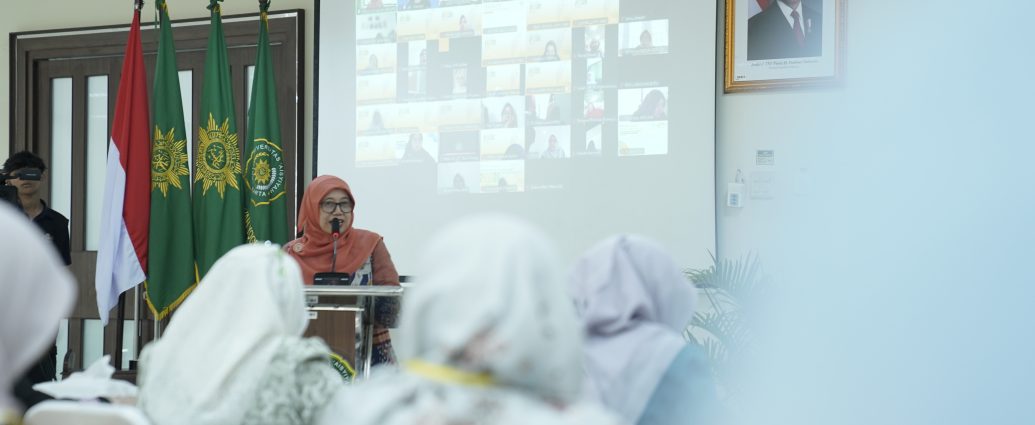
Yogyakarta, 11 June 2026 — The opening of the International Conference on Aisyiyah Studies (ICAS) 2026 was marked by welcoming remarks from Dr. Tri Hastuti Nur Rochimah, Secretary General of the Central Board of ‘Aisyiyah, who emphasized the importance of strengthening knowledge production, scholarly collaboration, and global engagement as part of Aisyiyah’s ongoing contribution to society.
Addressing participants from diverse academic, professional, and geographical backgrounds, Dr. Tri Hastuti expressed her appreciation to Universitas ‘Aisyiyah Yogyakarta, The Aisyiyah Center, researchers, presenters, and partner institutions for their commitment to advancing Aisyiyah Studies through academic inquiry and intellectual exchange.
She noted that ICAS 2026 represents an important milestone in the development of Aisyiyah Studies as a growing field of scholarship. For more than a century, Aisyiyah has been actively involved in education, health services, social welfare, economic empowerment, humanitarian work, and community development. Yet, despite its substantial contributions, many aspects of Aisyiyah’s experiences, ideas, and institutional innovations remain insufficiently documented and examined within academic literature.
According to Dr. Tri Hastuti, knowledge production is not separate from social transformation. Research, documentation, and publication are essential for preserving institutional memory, strengthening organizational learning, and ensuring that the contributions of Muslim women become part of broader scholarly and public conversations. In this regard, she welcomed the emergence of ICAS as a platform that encourages critical reflection on the history, thought, movement, and future trajectory of Aisyiyah.
Reflecting on the conference theme, “Strengthening Solidarity, Nurturing the Earth: Progressive Muslim Women’s Leadership for a Sustainable Civilization,” she emphasized that contemporary societies are facing increasingly complex challenges, including environmental degradation, technological disruption, social fragmentation, economic inequality, and humanitarian crises. These challenges, she argued, require collective responses that combine ethical commitment, intellectual creativity, and social responsibility.
Dr. Tri Hastuti highlighted that Aisyiyah’s long tradition of service provides valuable lessons for responding to these global issues. Throughout its history, Aisyiyah has demonstrated that faith-based organizations can contribute meaningfully to education, healthcare, women’s empowerment, and community resilience while remaining grounded in Islamic values. This experience, she suggested, holds relevance not only for Indonesia but also for wider international discussions on sustainable development, social justice, and women’s leadership.
She further encouraged scholars to move beyond viewing Aisyiyah solely as an object of historical study. Instead, she invited participants to engage with Aisyiyah as a living movement whose experiences can generate new theoretical insights, methodological innovations, and practical solutions for contemporary problems. Through interdisciplinary approaches, Aisyiyah Studies can contribute to conversations in Islamic studies, gender studies, sociology, anthropology, education, health sciences, environmental studies, and digital studies.
An important theme in her remarks was the need for stronger international engagement. While Aisyiyah has established a significant presence within Indonesia, she emphasized that its experiences and perspectives deserve greater visibility in global academic and policy discussions. Conferences such as ICAS provide opportunities to build international networks, foster collaborative research, and introduce Aisyiyah’s contributions to wider audiences.
Dr. Tri Hastuti also expressed optimism about the participation of younger scholars, researchers, and activists in the conference. She noted that the future of Aisyiyah depends not only on organizational continuity but also on the emergence of new generations capable of critically engaging with contemporary challenges while preserving the values that have guided the movement for more than a century.
Concluding her remarks, she called upon participants to view ICAS not as the end of a conversation, but as the beginning of a broader intellectual movement. She expressed hope that the ideas, partnerships, and research initiatives emerging from the conference would continue to grow and contribute to the advancement of knowledge, the strengthening of solidarity, and the realization of a more just, inclusive, and sustainable future.
Her welcoming remarks set an inspiring tone for the conference, reaffirming the importance of scholarship as a form of service and positioning Aisyiyah Studies as an increasingly important field for understanding the intersections of Islam, women’s leadership, social transformation, and global challenges.